
How far a security camera can see depends on what you need to see: an ordinary 4 MP camera with a 4 mm lens can detect a person at about 61 m, observe clothing at about 25 m, recognize a known face at about 12 m and identify someone at about 6 m. These distances come from the DORI standard (Detect, Observe, Recognize, Identify), which sets the pixel density needed at each level: 25, 62, 125 and 250 pixels per metre. Resolution and lens field of view set the rest. This page gives a distance table for 4 MP and 8 MP cameras with 2.8, 4 and 6 mm lenses, and how to use it to place cameras.
PCBy the Pixl Canada install team. Calculated October 26, 2026. 7 min read.
- DORI levels explained
- Distance tables by lens and resolution
- Why night distances are shorter
- How to choose the lens for a spot
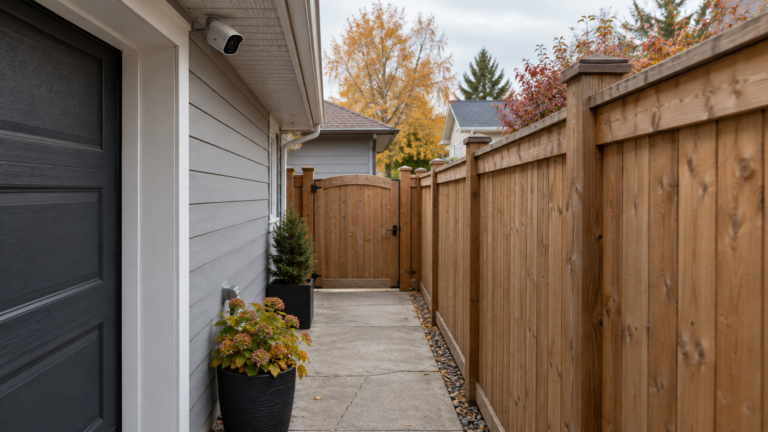
- DORI sets pixel-density targets: Detect 25, Observe 62, Recognize 125, Identify 250 pixels per metre.
- A wider lens covers more area but shortens every DORI distance.
- Identification distances are short. Put identification cameras at doors and gates, not across a lot.
- Night, glare and weather shorten real distances, so treat the tables as the best case.
What does DORI mean for a security camera?
DORI is a way of describing what a camera image is good for at a given distance. It is based on the IEC EN 62676-4 standard and sets four levels by the number of pixels across each metre of scene.
| Level | Pixels per metre | What it lets you do |
|---|---|---|
| Detect | 25 | Tell that a person or vehicle is present |
| Observe | 62 | See characteristics such as clothing and what is happening around an incident |
| Recognize | 125 | Tell with high certainty that a person is the same one seen before |
| Identify | 250 | Establish who someone is beyond reasonable doubt |
Pixels per metre is the camera’s horizontal pixel count divided by the width of the scene at that distance. A wider scene spreads the same pixels more thinly.
How far can a camera see at each DORI level?
Distances in metres for visible-light cameras in good light, calculated from the camera’s horizontal pixels and the lens’s horizontal field of view. Lens angles are typical values: about 100 degrees for 2.8 mm, 80 degrees for 4 mm and 55 degrees for 6 mm. Real lenses vary, so check the datasheet.
| Lens | Detect | Observe | Recognize | Identify |
|---|---|---|---|---|
| 2.8 mm (about 100°) | 43 m | 17 m | 9 m | 4 m |
| 4 mm (about 80°) | 61 m | 25 m | 12 m | 6 m |
| 6 mm (about 55°) | 98 m | 40 m | 20 m | 10 m |
| Lens | Detect | Observe | Recognize | Identify |
|---|---|---|---|---|
| 2.8 mm (about 100°) | 64 m | 26 m | 13 m | 6 m |
| 4 mm (about 80°) | 92 m | 37 m | 18 m | 9 m |
| 6 mm (about 55°) | 148 m | 59 m | 30 m | 15 m |
More pixels extend every distance by about 1.5 times (3,840 vs 2,560), which is why 4K helps at long range. See the 4K security camera guide. The cost is storage: see the storage calculator.
Why are real distances shorter at night and in bad weather?
| Factor | Effect |
|---|---|
| Night, infrared only | Infrared range is limited and image detail drops. See night vision cameras |
| Backlight and glare | Low sun or headlights wash out faces |
| Rain, snow and fog | Reduce contrast and detail |
| Dirty or iced lens | Blurs the whole image |
| Motion and low shutter speed | Moving subjects blur at night |
As a planning rule, treat the Recognize and Identify distances as the maximum in good daylight and assume noticeably less at night unless the area is lit. This is a rule of thumb, not a measured value.
How do you choose the right lens for a spot?
| Spot | Goal | Typical lens |
|---|---|---|
| Front door or entrance, 2 to 4 m away | Identify faces | 2.8 mm, mounted low enough for a face-level view |
| Driveway or yard, 8 to 15 m | Observe and recognize | 4 mm |
| Parking lot or fence line, 20 m and more | Detect and observe | 6 mm or a varifocal lens, or a PTZ. See parking lot cameras |
| Licence plates at a gate | Read plates | Dedicated plate camera. See licence plate cameras |
For where to put each camera, see where to place security cameras and how to choose a security camera.
Security camera distance: frequently asked questions
How far can a security camera see?
It depends on the goal. A 4 MP camera with a 4 mm lens can detect a person at about 61 m but identify someone only at about 6 m.
What does DORI stand for?
Detect, Observe, Recognize, Identify: four levels of image detail based on pixels per metre.
Does a higher resolution camera see farther?
It keeps useful detail farther away. 8 MP gives about 1.5 times the distance of 4 MP at the same lens.
What lens is best for a front door?
A wide lens such as 2.8 mm, mounted so faces are in view, works for entrances a few metres away.
Why is my night image worse than the daytime distance?
Infrared range, glare and motion blur shorten real distances at night. Add lighting or use a camera with colour night vision.
Can Pixl choose the lens for me?
Yes. Send photos of each spot and we recommend the camera and lens in a free written quote for wired CCTV. You pay after the job.
Get each camera matched to its spot
Send photos of the doors, driveway or site. Free written quote for wired CCTV. You pay after the job.
4K security cameras
Types of CCTV cameras
Night vision cameras
How high to mount a camera
Picture problems and fixes
Camera lenses explained
Thermal security cameras
Outdoor security cameras compared for Canadian winters
Sources and method. DORI thresholds (25, 62, 125 and 250 pixels per metre) are described in vendor explainers such as Infiniti Optics and are based on IEC EN 62676-4. Distances are calculated from horizontal pixels and typical lens angles, for visible-light cameras in good light. Check your camera’s datasheet and test at night.
About Pixl Canada. Pixl Canada is an installation company based in Edmonton, Alberta, serving cities across Canada with TV mounting, security cameras, appliance installation and smart home setup. Call or text (587) 899-7495. Open Monday to Saturday 8am to 8pm and Sunday 9am to 7pm.