
Yes, you can mount a TV on the ceiling, but only when the mount is fastened into solid framing, usually the ceiling joists, and the ceiling can carry the TV, the mount and any extra load. Ceiling mounts make sense in bedrooms, basements, kitchens, shops and rooms where wall space is limited. They are a poor fit for suspended tile ceilings, metal joists and big, heavy TVs unless the structure has been checked first.
PCBy the Pixl Canada install team. Updated . 7 min read.
- When a ceiling mount beats a wall mount
- Four mount types compared in one table
- Joist, weight and viewing-angle checks
- Market range $120 to $300 labour, fixed quote from a photo
- A ceiling mount must go into joists or solid blocking. Drywall alone cannot hold a TV.
- Check the mount’s weight rating and the ceiling structure. One manufacturer asks for a structure rated to four times the load.
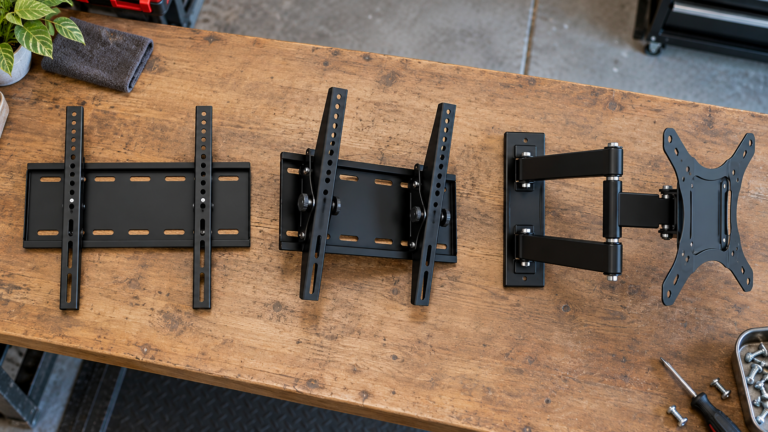
- Pole, flip-down, motorized and fixed-pitch mounts solve different problems.
- Tilt and eye level matter more on a ceiling than on a wall. Test the angle before drilling.
Is it a good idea to mount a TV on the ceiling?
It is a good idea when the wall is not an option and the ceiling is solid. It is a bad idea when you are only trying to avoid drilling into a wall, because a ceiling job asks more of the structure and of the person doing it.
| Room | Ceiling mount? | Why |
|---|---|---|
| Bedroom | Often a good fit | A flip-down TV watched from bed frees the wall and the dresser |
| Basement with exposed joists | Good fit | Joists are easy to find and reach |
| Kitchen or bar | Often a good fit | Cabinets and windows leave no wall space |
| Shop, waiting room or office | Often a good fit | The screen can hang above counters and walkways |
| Living room with a free wall | Usually a wall mount instead | Wall mounts are simpler and easier to adjust. See how high to mount a TV |
| Suspended tile ceiling | Not without a plan | Ceiling tiles cannot carry a TV. The load has to reach the structure above |
What types of ceiling TV mounts are there?
There are four common types: fixed or pitched-ceiling mounts, pole mounts, flip-down mounts and motorized drop-down mounts. The right one depends on the room and how often you move the screen.
| Type | How it works | Best for | Watch out for |
|---|---|---|---|
| Pole or fixed drop mount | A rod hangs from the ceiling plate and the TV rides on a tilt and swivel head | Shops, restaurants, basements | The TV stays in the room, so the ceiling height decides the viewing height |
| Flip-down | The TV folds up against the ceiling when not in use | Bedrooms, small rooms, vans and RVs | Usually rated for smaller, lighter TVs. Check the rating |
| Motorized drop-down | A motor lowers the TV and raises it flush to the ceiling on a remote | Bedrooms and media rooms | Needs a power outlet in the ceiling area and a higher structural rating |
| Pitched or vaulted ceiling mount | An adapter plate lets a pole mount sit on a sloped ceiling | Cathedral ceilings and lofts | Some mounts are not made for angled ceilings. Check the manual |
Look for a VESA pattern and weight rating that match your TV, the mount’s drop length and whether it works with your ceiling type. Browse the listing on the retailer’s page, then confirm everything against the manual that ships with the mount.
What does your ceiling need to hold a TV?
Your ceiling needs solid framing to fasten into, and enough capacity for the TV, the mount and any motion. Drywall anchors and ceiling tiles are not enough on their own.
| Check | What to look for |
|---|---|
| Framing | Wood joists are the usual target. Joist spacing is commonly 16 or 24 inches on centre, but confirm on site with a stud finder |
| Fasteners | Follow your mount’s manual. Several manuals call for lag bolts into joists, with extra blocking where the plate does not land on a joist |
| Weight capacity | Add the TV weight to the mount weight and stay well under the rated limit. One lift manufacturer asks for a structure rated at four times the total load |
| Ceiling type | Not for metal joists or angled ceilings unless the mount is rated for them |
| What is above | Pipes, wiring and ducts. Check before drilling a pilot hole |
| Power and cables | Plan where the HDMI and power lines run. Cable concealment affects the look more than the mount itself |
The SnapAV install guide for a large-TV ceiling mount tells installers to confirm that the ceiling can safely carry the combined weight of the mount and the display, and to drill at least two holes into a wood joist. A Monoprice ceiling lift manual calls for a structure with a load capacity of at least four times the total weight. Your own mount’s manual always wins over general advice.
How is a ceiling TV mount installed?
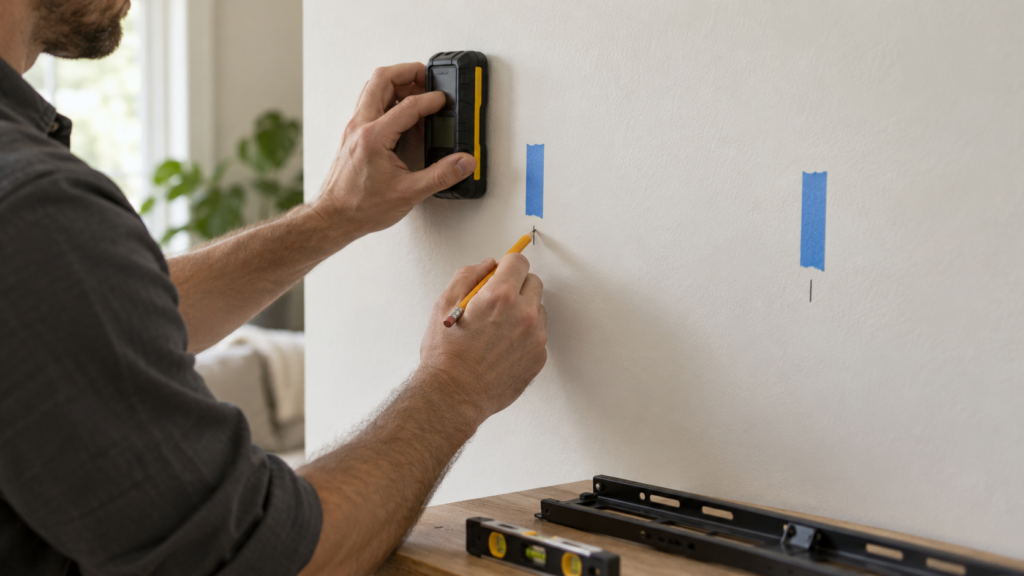
You find the joists, mark the plate, drill pilot holes, bolt the plate on, then attach the pole or arm, hang the TV and adjust the tilt. Two people make it far safer, because you will be holding a TV above your head.
- Choose the spot. Sit where you will watch and mark where the screen should be. Test the height and angle before any hole is drilled.
- Find the joists. Use a stud finder and mark the centre of each joist. Check for pipes, wiring and ducts above.
- Mark the plate. Hold the ceiling plate in place so its holes land in the joists, or plan blocking if they do not.
- Drill pilot holes. Use the bit size in the manual. Oversized holes weaken the joist.
- Fasten the plate. Use the supplied lag bolts and washers. Do not overtighten, because overtightening can damage the bolts and reduce holding strength.
- Attach the pole or arm and fit the brackets to the back of the TV first, on the ground.
- Hang the TV with a helper, lock every fastener, then set the tilt and swivel.
- Run and hide the cables, test the picture and check that nothing swings into a doorway or a light.
Need to hide the cables as well? See our guide to hiding TV wires (in French) or the English overview of TV mounting in Canada.
What is the right viewing angle for a ceiling-mounted TV?
The screen should tilt down toward the seat so that your eyes meet it near its centre. A TV hung high with no tilt makes you look up, which strains the neck and washes out the picture on many panels.
| Where you watch | Setup that works |
|---|---|
| From bed | Flip-down or motorized mount, lowered until the screen centre is slightly above lying eye level, tilted toward the pillow |
| From a sofa | Pole mount with a tilt head, screen centre near seated eye height |
| Standing at a counter | Mount higher and angle down toward where people stand |
| A busy room | Keep the screen out of the path of doors, ceiling fans and open cabinets |
The same eye-level rule applies to wall mounts. Read how high to mount a TV for the full numbers.
How much does a ceiling TV mount cost to install?
Installation labour for a ceiling TV mount typically runs about $120 to $300, and more for large TVs, motorized mounts or cable work. Published cost guides put general TV mount installation near $100 to $300 in the US, with ceiling jobs costing more because they need special hardware and extra effort, so treat this as a market range, not a fixed Pixl price. Mount hardware is separate, and a new ceiling outlet is electrical work for a licensed electrician. Text a photo of the ceiling, the TV size and the mount you are considering, and we confirm a fixed price before we book.
| Job | Typical range |
|---|---|
| Pole or fixed drop mount, TV up to about 55 inches | $120 to $220 |
| Flip-down or larger TV | $180 to $300 |
| Motorized drop-down mount | $220 to $400 |
| New ceiling outlet or circuit | Licensed electrician, quoted separately |
Standard wall mounting is posted. In Calgary and Edmonton, TV mounting starts at $79.99 for TVs up to 31 inches and $99.99 for 32 to 60 inches, before tax, with mounts available from $70. See TV mounting prices, or how to mount a TV on the wall.
Ceiling TV mount: frequently asked questions
Is it a good idea to mount a TV on the ceiling?
Yes, when wall space is limited and the mount is bolted into solid framing. It is a poor choice for suspended tile ceilings or a ceiling whose structure you have not checked.
Can I hang my TV from a ceiling mount?
Yes, if the mount’s weight and VESA ratings match your TV and the ceiling can carry the load. Fasten the plate into joists, not drywall alone.
How do you attach a TV to a ceiling?
Find the joists, mark and drill pilot holes, fasten the ceiling plate with lag bolts, attach the pole or arm, then hang the TV with a helper and adjust the tilt.
What type of ceiling TV mount should I choose?
Choose a pole mount for a fixed spot, a flip-down mount for a bedroom, a motorized mount if you want it to disappear into the ceiling, and a pitched-ceiling adapter for sloped ceilings.
Can you use a ceiling TV mount on a drop ceiling?
Not on the tiles. The load has to be carried by the structure above, so ask a qualified installer to look first.
How much does it cost to install a ceiling TV mount?
Labour typically runs about $120 to $300 depending on the mount and TV size, plus the mount itself. Text a photo to (587) 899-7495 and we confirm a fixed price before we book.
Not sure your ceiling can hold it?
Text a photo of the ceiling, the TV size and the mount. We will tell you what we would do. Same-day service is available when we have an opening.
How high to mount a TV
How to mount a TV on the wall
TV wall mounting in Canada
Pull-down and motorized TV mounts
Sources and method. SnapAV ceiling mount installation guide and Monoprice ceiling mount manual. Cost ranges are market estimates from published North American guides such as TaskRabbit and Fixr, mostly US-based, not a fixed Pixl price. General guidance only: always follow the manual for your mount. Pixl prices are in Canadian dollars, before tax.
About Pixl Canada. Pixl Canada is an installation company based in Edmonton, Alberta, serving cities across Canada with TV mounting, security cameras, appliance installation and smart home setup. Call or text (587) 899-7495. Open Monday to Saturday 8am to 8pm and Sunday 9am to 7pm.