
Appliances · 6 min read · updated oct 2026
Dryer Vent Length and Duct Rules in Canada
By the Pixl Canada install team
Quick answer
There is no single maximum dryer vent length. Your dryer’s installation manual sets the limit, based on the duct type, the number of elbows and the type of outside hood. As an example, LG allows 65 feet of rigid metal duct with no elbows and deducts 6 feet for each extra elbow. Always vent outdoors, use metal duct and keep the run as short as you can.
Washer and dryer installation is $110 side by side or $150 stacked, and a dryer duct adds $20. You pay after the job. See appliance installation
Where to find your dryer’s limit
Different brands and models have different charts, and some are very different. Look for a section called “venting” or “exhaust” in the installation instructions for your exact model. The limit usually depends on four things:
- Duct material: rigid metal usually allows a longer run than flexible duct.
- Number of 90 degree elbows: each turn reduces the allowed length.
- Type of outside hood: box, louvered or angled hoods have different limits.
- Duct diameter: most dryers use 4 inch duct.
If you have lost the manual, search for your model number and “installation instructions” on the manufacturer’s website.
Example: how an elbow limit works
LG’s help library gives a clear example for rigid metal duct with a 4 inch wall cap. Other brands use similar logic with their own numbers, so treat this as an illustration and not a rule for your dryer. See LG’s dryer venting and installation tips.
| 90 degree elbows | Maximum length of rigid metal duct (LG, 4 inch wall cap) |
|---|---|
| 0 | 65 ft (19.8 m) |
| 1 | 55 ft (16.8 m) |
| 2 | 47 ft (14.3 m) |
| 3 | 36 ft (11.0 m) |
| 4 | 28 ft (8.5 m) |
LG also says not to use more than four 90 degree elbows and to avoid plastic or vinyl duct. GE’s installation manuals add that turns should be separated by at least 4 feet of straight duct, that two 45 degree turns count as one 90 degree turn, and that a side exit adds one elbow to the count.
How to measure your vent run
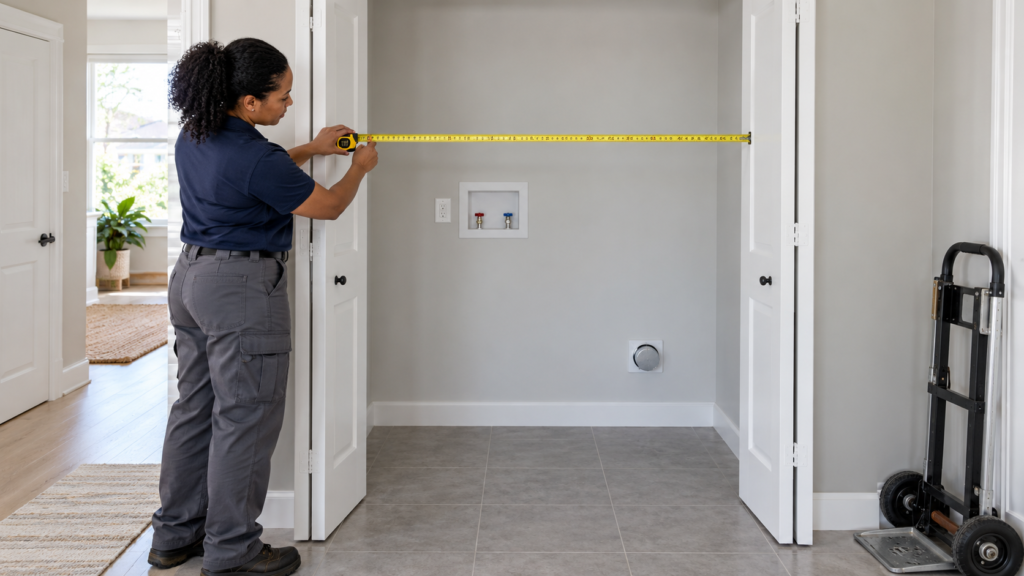
- Measure the straight sections from the back of the dryer to the outside hood.
- Count every 90 degree elbow. Two 45 degree bends count as one 90.
- Add one elbow if the dryer exits from the side, if your manual says so.
- Look up the allowed length for that number of elbows and your hood type.
- Compare. If your run is longer, shorten it or reduce the turns.
Washer and dryer installation is $110 side by side or $150 stacked, and a dryer duct adds $20. You pay after the job.
Which duct to use
| Duct type | Good for | Watch out for |
|---|---|---|
| Rigid metal | The best airflow; recommended for most runs | Needs careful fitting; seal joints |
| Semi-rigid metal | Short connections behind the dryer | Can crush if squeezed against the wall |
| Flexible foil | Only where the manufacturer permits it | Kinks and sags, which collects lint |
| Plastic or vinyl | Nothing | Can melt or ignite; avoid it |
The City of Toronto’s fire safety guidance says to use rigid or flexible metal ducting and warns that plastic or foil duct is more prone to kinking, sagging and crushing, which builds up lint. See Toronto’s clothes dryer fire safety page. The GE and LG manuals note that in Canada only foil-type flexible ducts identified for use with the dryer should be used, if any.
Signs your vent is too long or clogged
| Sign | Likely cause | What to do |
|---|---|---|
| Clothes take two cycles to dry | Blocked or too-long duct | Clean the duct and check the run length |
| Dryer and laundry room feel very hot | Poor airflow | Check for crushed or kinked duct |
| Lint around the dryer or hood | Loose joints or a leak | Seal joints with foil tape |
| Musty smell or damp windows | Moist air is not leaving the house | Confirm that the dryer vents outdoors |
| Outside hood flap does not open | Lint or snow blocking the hood | Clear the hood |
Venting outdoors and in winter
Health Canada says to check that your clothes dryer vents outside, to seal the duct joints with foil tape and to keep the outside vent clear of obstructions such as snow and foliage. See the Health Canada guide to addressing moisture and mould in your home. Venting into an attic, crawl space or garage puts moist air and lint inside the building and is not acceptable.
How often to clean
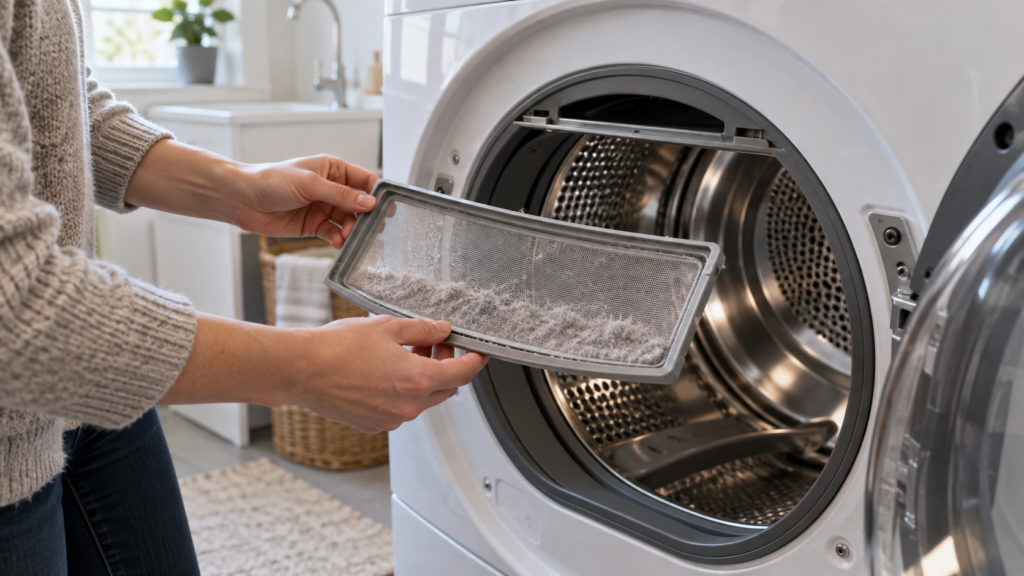
Natural Resources Canada treats lint in the exhaust duct and outside vent as a potential fire hazard and says to inspect and clean them at least once a year. The NFPA’s consumer tip sheet gives the same baseline, or more often if drying takes longer than normal. See the NFPA dryer safety tips. Clean the lint screen after every load, and do not dry foam or rubber items.
Two worked examples
These examples use LG’s chart from the table above. Your dryer’s numbers may be different, so check your manual.
| Setup | Count | Allowed | Result |
|---|---|---|---|
| Laundry room against an outside wall: 8 ft of straight duct and 1 elbow | 8 ft, 1 elbow | 55 ft | Well within the limit |
| Basement laundry: 30 ft of duct to a rim-joist hood with 3 elbows | 30 ft, 3 elbows | 36 ft | Within the limit, but close, so keep it clean |
| Interior laundry: 45 ft of duct with 3 elbows | 45 ft, 3 elbows | 36 ft | Too long; shorten it or remove turns |
Tight spaces and short runs
When the dryer sits close to the wall, a crushed duct is the usual problem. Use a rigid or semi-rigid elbow close to the dryer instead of bending flexible duct sharply, and leave enough space behind the machine. Check your manual for the minimum clearance. Never squeeze duct behind the dryer to gain space.
Questions to ask before you book an install
- How long is the duct run, and how many turns does it have?
- Where does the vent exit: through a wall, the rim joist or the roof?
- Is the existing duct metal, and is it clean and sealed?
- Is the outside hood clear, and does the flap open and close?
- Is it a gas or electric dryer, and does your manual list a different limit?
What we install and what it costs
At Pixl Canada, washer and dryer installation is $110 for side by side and $150 for stacked, before tax. A dryer duct adds $20, and you pay after the job. We connect the water hoses, level the machines and vent the dryer outside with metal duct. If your run looks long or has many turns, tell us when you book. See our washer and dryer installation guide and appliance installation.
Frequently asked questions
How long can a dryer vent be?
It depends on your dryer. Manufacturers publish limits based on duct type, elbows and hood type. For example, LG allows 65 feet of rigid metal duct with no elbows and less with each turn. Check your manual.
Can I use a flexible foil dryer duct?
Only if your manufacturer allows it. Foil duct kinks and traps lint, and Canadian guidance in dryer manuals says only foil-type ducts identified for use with the dryer should be used.
Can a dryer vent run into the attic or garage?
No. A dryer must vent directly outdoors, because it releases moist air and lint.
How often should I clean the dryer vent?
At least once a year. Do it more often if drying takes longer than normal or you dry many loads.
Why does my dryer take so long to dry?
A clogged, kinked or overly long vent is a common cause. Check the lint screen, the duct and the outside hood.
Can I use plastic duct?
No. Plastic and vinyl duct can melt or ignite and are not recommended by manufacturers or fire departments.
This guide is general information. Your dryer’s installation manual and local building code take priority. Gas dryers have additional gas-connection requirements.
Ready to book? Washer and dryer installation is $110 side by side or $150 stacked, and a dryer duct adds $20. You pay after the job.
See also washer and dryer installation cost and the appliance installation guide. Written by the Pixl Canada install team: licensed technicians with $5 million liability insurance, installing TVs, security cameras, smart home devices and appliances across Canada.
Related articles