
Smart devices · 7 min read · updated oct 2026
Thermostat Wiring Explained: R, W, Y, G, C and O/B
By the Pixl Canada install team
Quick answer
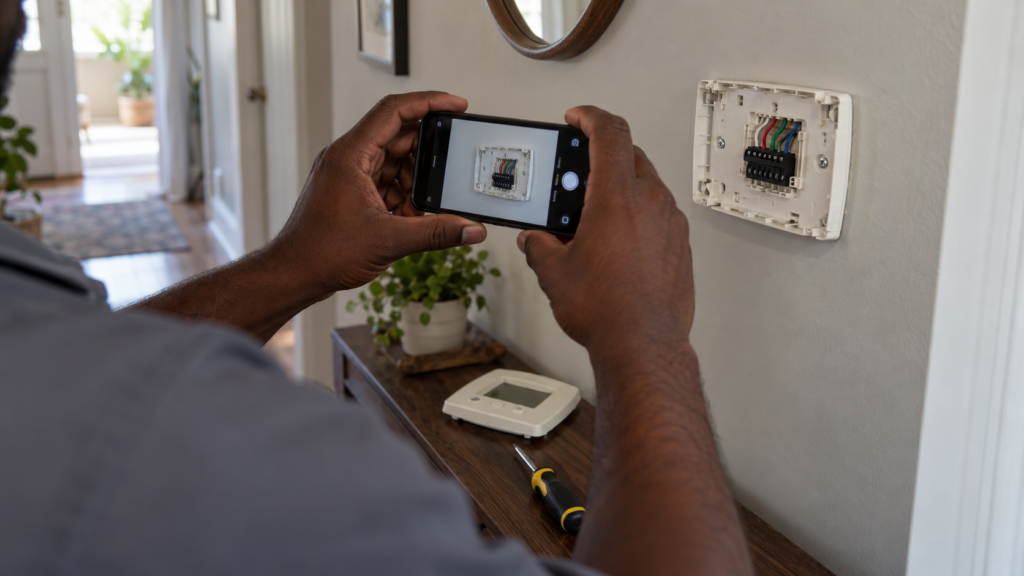
Match thermostat wires by the letter on the terminal, not by colour. R brings 24 V power, W calls for heat, Y calls for cooling, G runs the fan, C is the common wire that powers a smart thermostat, and O/B controls a heat pump’s reversing valve. Turn off power at the furnace, photograph the wires before you disconnect anything, and stop if the thermostat is labelled 120 V or 240 V, because that is a different type of system.
Smart thermostat installation is $129 before tax, and a C-wire adapter adds $50 when required. You pay after the job. See smart home prices
What the thermostat wire letters mean
This table covers the terminals on most low-voltage (24 V) thermostats. Your base may show only some of them. The meanings follow ecobee’s support guidance and iFixit’s guide to thermostat wiring letters.
| Terminal | What it does | Notes |
|---|---|---|
| R, Rc, Rh | Power from the transformer | A single R wire powers the whole system. Separate Rh and Rc wires feed heating and cooling |
| W, W1, W2 | Heating stages | W2 is a second stage. On a heat pump, W or Aux often calls for backup heat |
| Y, Y1, Y2 | Cooling, or the heat pump compressor | Y2 is a second stage on two-stage equipment |
| G | Blower fan | It is not a ground wire |
| C | Common wire that gives the thermostat constant power | Not every system has one |
| O/B | Heat pump reversing valve | O changes to cooling and B changes to heating, and some systems use one combined O/B wire |
| Aux, X | Auxiliary heat | Used when a heat pump needs help in cold weather |
| E | Emergency heat | Found on some heat pump thermostats |
| L | Indicator lights or a fault signal | Seen on some systems |
Why wire colour is not enough
Colours are a habit, not a rule. A red wire is often power and a white wire is often heat, but an installer may have used any colour. ecobee warns that putting wires into the wrong connectors can make the system malfunction or even damage it. It also notes that a wire labelled B is usually the heat pump valve, but on some thermostats it is the common (C) wire. If a common wire goes into any connector other than C, the system’s fuse can be damaged or blown when power returns.
Use the letter on each terminal. If the labels have faded, or the wires have no labels, do not guess. Compare the wires with the connectors on the furnace control board, as described below.
The most common wiring setups
| System | Wires you often see | What to know |
|---|---|---|
| Furnace only, older home | R and W | Two wires is common. There is often no C wire, so a smart thermostat may need an adapter |
| Furnace and air conditioner | R, W, Y, G and sometimes C | The most common setup in Canadian homes with central air |
| Heat pump | O/B, Y, G, Aux or E and sometimes C | An orange wire in the O/B-W connector usually points to a heat pump, but check the other wires too |
| Two transformers | Separate Rc and Rh wires | Needs a thermostat that supports it. A power extender kit does not |
| Electric baseboard heat | Thick wires, 120 V or 240 V | Line voltage. This is a different job. See baseboard heater thermostats |
ecobee’s rule for heat pumps: if, in addition to a wire in the O/B-W1 connector, you see wires on Y1 and on Aux-W2, Aux or Aux/E, you have a heat pump.
Smart thermostat installation is $129 before tax, and a C-wire adapter adds $50 when required. You pay after the job.
Jumpers, unused wires and the Rc and Rh terminals
- Jumpers. A jumper is a short wire or staple joining two terminals, usually Rc and Rh. ecobee says not to connect jumpers from the old thermostat, because its thermostats use an internal jumper when a system needs it.
- One R wire. If there is only one R wire, ecobee says to connect it to Rc.
- Unused wires. Do not connect wires that were not connected to the old thermostat, unless you are using one deliberately as the C wire.
- One wire per terminal. Do not push two wires into one connector.
How to find (or add) a C wire
- Look for a wire already on C at the old thermostat. If there is one, it must also be connected to the C terminal on the furnace control board.
- Check for an unused wire. ecobee says that if nothing is on C, in most but not all cases an unused wire in the bundle can serve as the C wire, as long as it is connected to C on the control board at the other end.
- Use an adapter or extender kit. Some smart thermostats include a power extender kit or have an adapter available. ecobee says its kit works only on 24 V systems and not on dual-transformer ones.
- Ask a professional. If you cannot reach the furnace or are unsure which wire is which, a technician can identify the system and wire it.
Our C wire thermostat guide goes through each option, and how to install a thermostat covers the whole swap.
How to check the furnace control board safely
- Turn the HVAC system off at its switch or the breaker, and confirm that no air is coming from the vents and no lights are on at the furnace.
- Remove the thermostat from the wall and photograph the wires.
- Confirm each wire is a different colour. If not, you cannot tell them apart on the board and should call a professional.
- Remove the control board panel and look for the connector labels, such as R, W, G, Y, C and O/B. The C connector may be labelled C, Com or Com 24V.
- Photograph the labels and compare them with the wires from the thermostat.
- Close the panel firmly, because some systems will not start with it open.
Do not touch parts inside the furnace. Some equipment holds large capacitors that store electricity.
Line voltage is different
If your thermostat is labelled 120 V or 240 V, or has thick wires joined with wire nuts, it controls electric baseboards or similar equipment. Do not use the 24 V steps in this guide. Those jobs involve mains voltage and call for the right thermostat model and often a licensed electrician.
Common wiring mistakes
- Going by colour alone. Match the letters, and check the control board when in doubt.
- Not taking a photo. Photograph the wires before you disconnect anything, and label each wire with tape.
- Treating B as O/B when it is C. Check this before you power up.
- Carrying over a jumper. Leave it off if the new thermostat adds its own.
- Working with power on. Turn the system off first.
Book a thermostat install
At Pixl Canada, smart thermostat installation is $129 before tax, and a C-wire adapter adds $50 when it is required. You pay after the job. We check the wiring and compatibility before the old thermostat comes off. See smart home installation and the smart home installation cost guide.
Frequently asked questions
What do the letters on a thermostat mean?
R is power, W is heat, Y is cooling, G is the fan, C is the common wire for constant power and O/B controls a heat pump’s reversing valve. Match wires by the terminal letter.
Is the red wire always power?
Often, but not always. Wire colours are a habit and not a rule, so go by the letter on the terminal and, if unsure, check the control board.
What is the C wire on a thermostat?
It is the common wire that completes the 24 V circuit and gives a thermostat constant power. Smart thermostats use it because their screens and WiFi draw power all day.
Should I connect the jumper wire to my new thermostat?
Usually not. ecobee says not to connect jumpers from the old thermostat, because its thermostats use an internal jumper between Rc and Rh when needed. Check your new model’s instructions.
Can I use a thermostat with two wires?
Often yes, but a smart thermostat may need an adapter or an unused wire to provide constant power. A basic or battery model can work on two wires.
How much does thermostat installation cost with Pixl?
Smart thermostat installation is $129 before tax, and a C-wire adapter adds $50 when needed. You pay after the job.
This guide is general information for low-voltage thermostats. Always follow the manual for your thermostat and HVAC equipment, and use a licensed professional when you are unsure.
Ready to book? Smart thermostat installation is $129 before tax, and a C-wire adapter adds $50 when required. You pay after the job.
Written by the Pixl Canada install team: licensed technicians with $5 million liability insurance, installing TVs, security cameras, smart home devices and appliances across Canada.
Related articles