
The heating system decides the thermostat: a furnace, heat pump or boiler on 24-volt wiring takes a standard smart thermostat, while electric baseboard heaters on 120 or 240 volts need a line-voltage smart thermostat that is wired as electrical work. Google’s own compatibility page lists electric baseboard heaters as incompatible with Nest thermostats. Pixl’s published smart thermostat install is $129 plus $50 if a C-wire adapter is needed, for standard low-voltage swaps. This page matches each heating system to the right type.
PCBy the Pixl Canada install team. Checked October 27, 2026. 8 min read.
- Eight Canadian heating systems matched to thermostat types
- How to tell 24 V from line voltage in a photo
- Baseboard load calculation
- When to call an electrician
- Find out your system and voltage before you buy a thermostat.
- Two thick wires with wire nuts and a 120 V or 240 V label mean line voltage. A standard smart thermostat will not work there.
- Heat pumps need a thermostat that supports reversing valve and backup heat wiring. Use the maker’s compatibility checker.
- Line-voltage wiring is regulated electrical work. Ask a qualified electrician or your provincial electrical authority.
Which smart thermostat suits which heating system?
| Heating system | Control voltage | Thermostat type | Notes |
|---|---|---|---|
| Gas or propane forced-air furnace, with or without AC | 24 V | Standard smart thermostat | May need a C-wire or adapter. See the C wire guide |
| Air-source or cold-climate heat pump | 24 V | Smart thermostat that supports heat pumps | Needs reversing valve (O/B) and backup heat wires handled. Use the maker’s checker |
| Electric furnace | Usually 24 V | Standard smart thermostat | Confirm from the label and the wires |
| Hydronic boiler with zone valves | Often 24 V, sometimes line voltage | Depends on the valve | Photograph the thermostat label and wiring first |
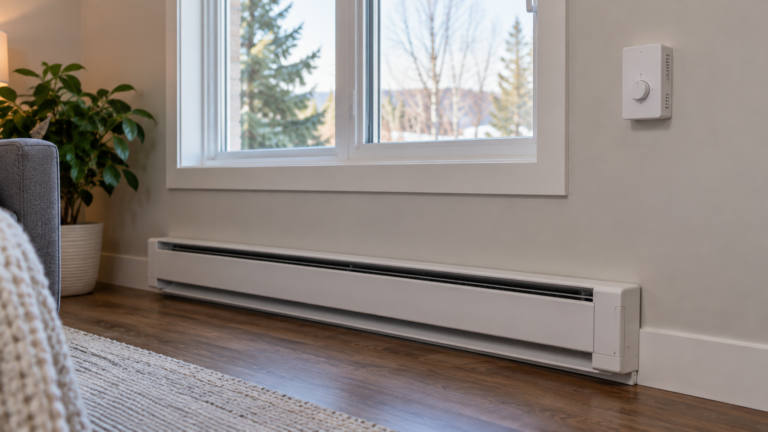
| Electric baseboard or in-wall heaters | 120 or 240 V | Line-voltage smart thermostat | Standard 24 V models are not for this. See baseboard thermostats in Canada |
| Electric radiant floor | Line voltage | Line-voltage thermostat, often with a floor sensor | Electrician job |
| Millivolt systems (gas fireplace, older wall heater) | About 750 mV | Millivolt-compatible thermostat only | Most smart thermostats do not support millivolt. Check the datasheet |
| Condo fan coil | Often 24 V with fan-speed wires | Check compatibility | Ask the condo corporation first |
How can you tell 24 V from line voltage?
| What you see | What it usually means |
|---|---|
| 4 to 8 thin coloured wires on small terminals marked R, W, Y, G | 24 V low-voltage system |
| Two thick wires joined with wire nuts | Line voltage, often baseboard |
| “120 V” or “240 V” printed on the thermostat | Line voltage |
| Only 2 thin wires | Millivolt or a 2-wire 24 V heat-only system. Photograph and check |
| Wires marked O/B or a heat pump label | Heat pump |
Google describes the high-voltage case the same way: a thermostat labelled 120 V or 240 V with two thick wires and wire nuts. For the letters and terminals, read thermostat wiring explained. A photo with the cover off lets us tell you which case you have.
How much load can one baseboard thermostat control?
Line-voltage thermostats are rated in watts. One widely sold baseboard model lists 3,800 W at 240 V or 1,900 W at 120 V (16 A maximum), and the total of all heaters on that thermostat must stay under the rating. Amps are watts divided by volts. Check your own thermostat’s datasheet.
| Room | Heaters | Total watts | Amps at 240 V | Against a 3,800 W rating |
|---|---|---|---|---|
| Bedroom | 1 x 1,000 W | 1,000 W | 4.2 A | Within the rating |
| Living room | 2 x 1,500 W | 3,000 W | 12.5 A | Within the rating |
| Open basement | 3 x 1,500 W + 1 x 1,000 W | 5,500 W | 22.9 A | Over. Split across thermostats |
| Large room | 4 x 1,500 W | 6,000 W | 25.0 A | Over. Split across thermostats |
Heaters on a 120 V circuit draw twice the current for the same watts, so the 120 V limit is half. The load check is one reason baseboard thermostats are an electrical decision, not a plug-and-play swap.
When do you need an electrician?
- Line voltage (120 or 240 V). BC Hydro states that installing a hardwired smart thermostat is regulated electrical work in British Columbia and advises confirming permit requirements. Rules on who may do this work differ by province, so ask your provincial electrical authority.
- New thermostat wiring in the wall. A new run for a C-wire or a new thermostat location is a wiring job, not part of a standard swap.
- Anything inside the furnace or the breaker panel. Do not open them without the right qualification.
- Step-down transformers for baseboard. Google notes a local professional may be able to adapt a high-voltage system. We do not recommend DIY.
What Pixl fits is a standard low-voltage thermostat swap, with the C-wire adapter when the thermostat’s kit includes one. Send a photo and we tell you whether your job is ours or an electrician’s.
What does each path cost?
| Path | Device | Installation | Total |
|---|---|---|---|
| 24 V furnace, C-wire present | $150 to $330 | $129 (Pixl) | $279 to $459 |
| 24 V furnace, adapter needed | $150 to $330 | $129 + $50 (Pixl) | $329 to $509 |
| Heat pump, standard 24 V wiring | $150 to $330 | $129 (Pixl) | $279 to $459 |
| Baseboard, per room | $70 to $150 each (estimate) | Electrician quote | Varies |
Pixl’s prices are those on the smart thermostat installation page. Rebates can offset some of the device cost. See smart thermostat rebates in Canada.
You are unsure whether a Nest, ecobee or other smart thermostat will work with your heating, or you have baseboard or a heat pump.
You already have a confirmed 24 V furnace and just need it fitted. Go to how to install a thermostat or book the install.
Smart thermostats and heating systems: frequently asked questions
Will a Nest or ecobee work with electric baseboard heaters?
No. Google’s compatibility page says high-voltage systems such as electric baseboard heaters are not compatible with Nest thermostats, and standard 24 V models are generally built for low-voltage wiring. Use a line-voltage smart thermostat.
Can a smart thermostat control a heat pump?
Many can, but check the maker’s compatibility checker for your equipment. A heat pump uses reversing valve and backup heat wiring that not every thermostat handles.
Do I need a C-wire?
Many smart thermostats need steady power from a C-wire. If yours has none, an adapter or a new wire is an option. Pixl lists the C-wire adapter at +$50.
Can I replace a baseboard thermostat myself?
Line-voltage wiring is regulated electrical work in some provinces. Ask your provincial electrical authority or a qualified electrician before you touch it.
What if my heater has only two wires?
It may be line voltage, millivolt or a heat-only 24 V system. Photograph the wires and the label and send them to us before you buy.
How many baseboard heaters can one thermostat control?
As many as fit under the thermostat’s watt rating. At 240 V, a 3,800 W thermostat can handle for example two 1,500 W heaters but not four.
How much does smart thermostat installation cost?
Pixl’s published price is $129 for a smart thermostat install and $50 for a C-wire adapter when needed, before tax. Line-voltage and new wiring are quoted separately. Fixed quote from photos before booking, and you pay after the job.
Send a photo of your thermostat and its wires
We tell you which type you need and what we fit. Fixed quote from photos before booking. Pay after the job.
C wire thermostat guide
Thermostat temperature in winter
Smart home packages by home type
Book an ecobee install
Book a Nest install
Best smart thermostat in Canada
Sources and method. Nest compatibility statements come from Google’s Nest thermostat compatibility page. Line-voltage description, regulated electrical work and permit advice come from Google and from BC Hydro’s smart thermostat page. The 3,800 W at 240 V and 1,900 W at 120 V rating is from one manufacturer’s published specification for a baseboard thermostat. Checked October 27, 2026. The load table was calculated with Python: amps = watts divided by 240, for example 5,500 W divided by 240 V = 22.9 A. Device prices are rounded market estimates in CAD. Baseboard thermostat price and installation are estimates, not Pixl prices. Check your product’s datasheet.
About Pixl Canada. Pixl Canada is an installation company based in Edmonton, Alberta, serving cities across Canada with TV mounting, security cameras, appliance installation and smart home setup. Call or text (587) 899-7495. Open Monday to Saturday 8am to 8pm and Sunday 9am to 7pm.