
Security cameras · 5 min read · updated oct 2026
What Is CCTV? How a CCTV Security Camera System Works
By the Pixl Canada install team
Short answer
CCTV stands for closed-circuit television. It is a video system where cameras send pictures over a private connection to a recorder and screens, instead of broadcasting them. Today the term usually means a wired security camera system: cameras, cables, a recorder (a DVR or an NVR), a hard drive and an app or monitor for viewing. It records footage, but it does not watch your property by itself unless a monitoring service is added.
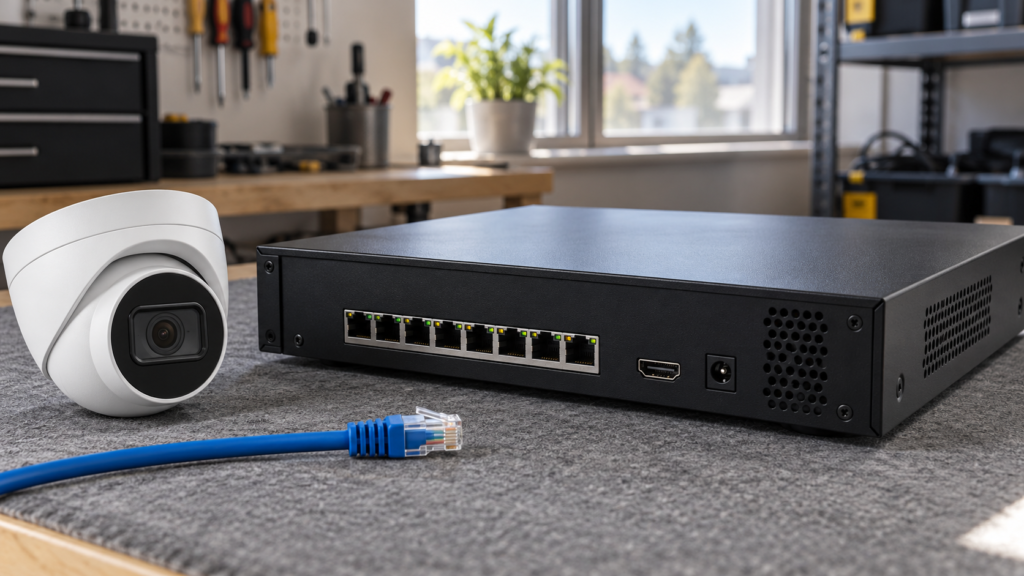
Wired CCTV and business systems get a free custom quote after a walkthrough, and WiFi cameras start at $200 for 1 or 2 cameras. You pay after the job. See camera installation
What CCTV means
“Closed-circuit” describes how the signal travels. A normal TV channel is sent out to anyone who can receive it. A CCTV signal goes only to the equipment it was built for, such as a recorder in a cabinet or a screen in an office. The word is still used even though modern systems often send video over a computer network and let owners view it on a phone.
In everyday Canadian use, “CCTV”, “security camera system” and “surveillance system” mean almost the same thing. The difference is in the wiring and the recorder, which is what the rest of this guide explains.
The parts of a CCTV system
| Part | What it does |
|---|---|
| Cameras | Capture the video. Common styles are dome, bullet and turret |
| Cabling | Carries video, and often power, from each camera to the recorder |
| Recorder | Receives and stores the video. A DVR works with coax cameras, and an NVR works with network cameras |
| Storage | A hard drive in the recorder holds the footage until it is overwritten |
| Power | Each camera needs power, either from a separate adapter or over the network cable |
| Viewing | A monitor, or a phone and computer app for live view and playback |
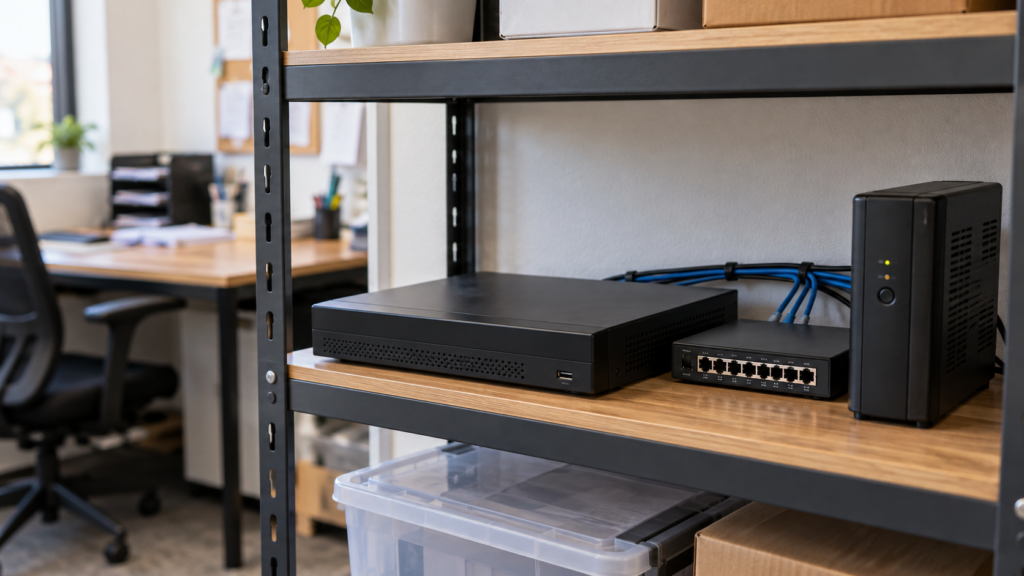
Analog, HD analog and IP: the three kinds of CCTV
| Type | How it connects | Recorder | Good to know |
|---|---|---|---|
| Traditional analog | Coaxial cable with BNC connectors | DVR | Lower resolution and power usually supplied separately |
| HD analog (AHD, HD-TVI, HD-CVI) | The same coaxial cable as older analog cameras | DVR that supports the format, often a hybrid | Higher resolution, and a way to upgrade without new cable. These formats are still analog |
| IP (network) | Ethernet cable, often with Power over Ethernet (PoE) | NVR | Usually the best choice for a new install, with one cable for power and data |
HD analog suits a building that already has coax cable and cameras you want to improve, because the cable can often be reused. A new system usually goes with IP cameras and PoE. Our guides to NVR vs DVR and how to install security cameras go into the cabling and recorder choices.
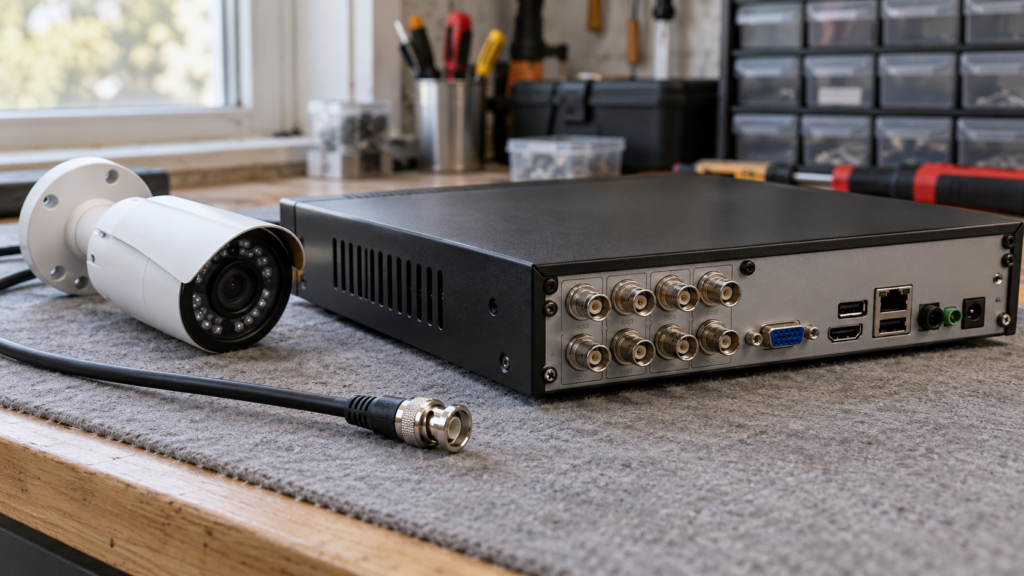
CCTV, security camera, IP camera and WiFi camera: how the words differ
| Term | Usually means |
|---|---|
| CCTV | A wired camera system that records to a local recorder |
| Security camera | Any camera used for security, wired or wireless |
| Surveillance camera | The same thing, often used for businesses and public places |
| IP camera | A camera that sends video over a network, with or without a recorder |
| WiFi camera | A camera that connects to your WiFi, often with cloud or memory-card storage |
A wired CCTV system records to its own hard drive and keeps working when the internet is down. Internet is needed only for remote viewing on your phone. A WiFi camera depends on your network and its app. See cloud storage vs a local NVR for how storage changes what happens in an outage.
What CCTV can and cannot do
- It records and lets you review. Most systems store footage for days or weeks, depending on the drive size, the video quality and the recording settings.
- It does not guard your property by itself. Unless you add a monitoring service or alerts that you act on, someone must watch the live view or review the clips.
- It is a deterrent and evidence tool. Visible cameras and clear footage help in an investigation. See giving police your camera footage.
- It has privacy rules. Cameras should cover your own property, avoid private spaces and often need a sign. Read security camera laws in Canada and do you need a sign.
Questions to answer before you plan a CCTV system
- What must each camera see? A face at the door, a plate at the gate, a general view of a yard or a till are different jobs.
- Can cables reach each position? Wired systems are only as good as their cable routes through attics, soffits and walls.
- Do you already have cable or cameras? Existing coax may suit an HD analog upgrade.
- How long should footage be kept? The answer sets the hard drive size.
- Who will have access? Decide who has the admin login and who can only view.
- Is it a home or a business? Businesses have extra privacy duties. See the business security camera system guide.
Plan a CCTV system with Pixl Canada
Wired CCTV and business systems get a free custom quote after we look at the property, and you pay after the job. If you only need one or two cameras, WiFi camera installation starts at $200 for 1 or 2 cameras. See security camera installation or read our guide to where to place cameras.
Frequently asked questions
What does CCTV stand for?
CCTV stands for closed-circuit television: a video system where the signal goes only to the connected recorder and screens instead of being broadcast.
Is CCTV the same as a security camera?
In everyday use, mostly yes. CCTV usually refers to a wired system with a recorder, while “security camera” can also mean a single WiFi camera or doorbell.
Does CCTV record all the time?
It can. Most systems record continuously or only when motion is detected, and you choose which in the recorder settings. Continuous recording uses more storage.
Does CCTV need the internet?
No, a wired system records to its own drive without the internet. You need an internet connection only to view the cameras remotely on a phone or computer.
What is the difference between CCTV and an IP camera?
An IP camera is a camera that sends video over a network. Many modern CCTV systems use IP cameras with a network recorder, while older systems use analog cameras and a DVR.
Is it legal to have CCTV at home in Canada?
Generally yes, if you film your own property, avoid private spaces such as a neighbour’s windows and do not record private conversations. Rules vary, so read our law guide and ask a lawyer about your setup.
This guide is general information. Equipment capabilities differ by model, so check the specifications before you buy.
Ready to book? Wired CCTV and business systems get a free custom quote after a walkthrough, and WiFi cameras start at $200 for 1 or 2 cameras. You pay after the job.
Written by the Pixl Canada install team: licensed technicians with $5 million liability insurance, installing TVs, security cameras, smart home devices and appliances across Canada.
Related articles