
Security cameras & the law: what Canadians need to know before installing
- Pay after the job
- Open 7 days
- $5M liability insurance
Before you buy a single camera, it helps to know this: the legal side of home security in Canada trips up more people than the technical side. What you’re allowed to record, where a camera can point, and what happens if it captures audio are all governed by federal criminal law and provincial privacy legislation that most buying guides never mention. This is the guide that covers both sides — the law and the hardware — in one place.
Why security cameras are different in Canada
Canadian demand for home security cameras is being pulled in a direction most people don’t expect: rural, not urban. National crime severity ticked down slightly in the latest reporting year, but rural crime rates ran roughly 42% higher than urban rates — a gap wide enough that it’s reshaping where demand for perimeter surveillance is growing fastest.
The hardware market splits cleanly into two camps. Consumer wireless systems (Ring, Nest, Arlo) are easy to self-install and lean on cloud subscriptions for storage. Professional PoE (Power over Ethernet) systems run on continuous wired power, store footage locally on a network video recorder, and avoid the monthly fee entirely — the tradeoff is a proper install.
The buying decision usually comes down to trust as much as hardware — letting a technician onto your property and into your home network is a bigger ask than picking a camera resolution. Verifying licensing (covered further down) matters as much as comparing spec sheets.
What most guides get wrong about camera laws here
Search for camera laws in Canada and most of what comes back is written for an American audience — “two-party consent states,” the First Amendment, state-by-state wiretapping maps that have no bearing here. None of it mentions the Criminal Code, and almost none of it flags that Ontario has no privacy statute at all and relies entirely on a common-law tort instead.
That gap matters because the actual Canadian rules are stricter in some ways and looser in others than the American content implies. Getting it from a source that’s actually looking at Canadian law — not a translated version of American guidance — is worth the extra search.
The federal law almost nobody mentions
Canada is a one-party consent jurisdiction: intercepting a private communication is a federal crime under section 184 of the Criminal Code unless at least one party to the conversation consents. If your camera’s microphone happens to capture a conversation between two other people on the sidewalk or driveway — a conversation you’re not part of — recording it without consent is an indictable offence.
Section 162 adds a second layer: voyeurism. Pointing a camera at a space where someone has a reasonable expectation of privacy — a neighbour’s window, an enclosed backyard — can cross a line regardless of intent.
Provincial privacy rules: it depends where you live
On top of federal law, where you live changes what applies to your specific install.
Ontario has no provincial privacy statute that covers neighbour cameras, so residential disputes fall to the common law tort of “intrusion upon seclusion,” established in Jones v. Tsige. It lets someone sue for an unwarranted privacy invasion without proving financial harm — and the stakes can be enormous. See the case study below.
BC and Alberta fall under their respective Personal Information Protection Acts, which cover organizations, not a homeowner’s personal camera. BC, Manitoba, Saskatchewan and Newfoundland and Labrador also have Privacy Acts that make a wilful violation of privacy a civil wrong. In BC, the Office of the Information and Privacy Commissioner requires strata councils to formally authorize camera installations, and individual doorbell cameras can’t continuously monitor shared hallways.
Quebec runs the strictest framework in North America under Law 25. Businesses operating cameras must designate a privacy officer and conduct Privacy Impact Assessments; penalties for non-compliance can scale up to $10 million or 2% of global turnover.
Manitoba, Saskatchewan, and the Maritime provinces have a Privacy Act of their own (Manitoba, Saskatchewan) or fall back on the federal PIPEDA for commercial activity. For a neighbour’s camera, disputes usually turn on a Privacy Act claim where one exists, or on private nuisance, municipal bylaws and, in serious cases, the Criminal Code.
The $22.5 million lesson
The clearest illustration of what “intrusion upon seclusion” actually costs in Canada is J.C. et al. v. Jugenburg et al. — a 2026 Ontario Superior Court class action involving cameras placed in clinic consultation rooms.
The lesson generalizes well beyond clinics: where a camera points, not just what happens to the footage afterward, is what the law evaluates.
PoE vs. wireless: surviving a Canadian winter
Standard battery-powered cameras lose voltage fast below −20°C, which is a real problem for a Canadian winter, not an edge case. Lithium-ion cells in particular can drop below their functional threshold overnight, leaving a camera offline exactly when it’s needed most.
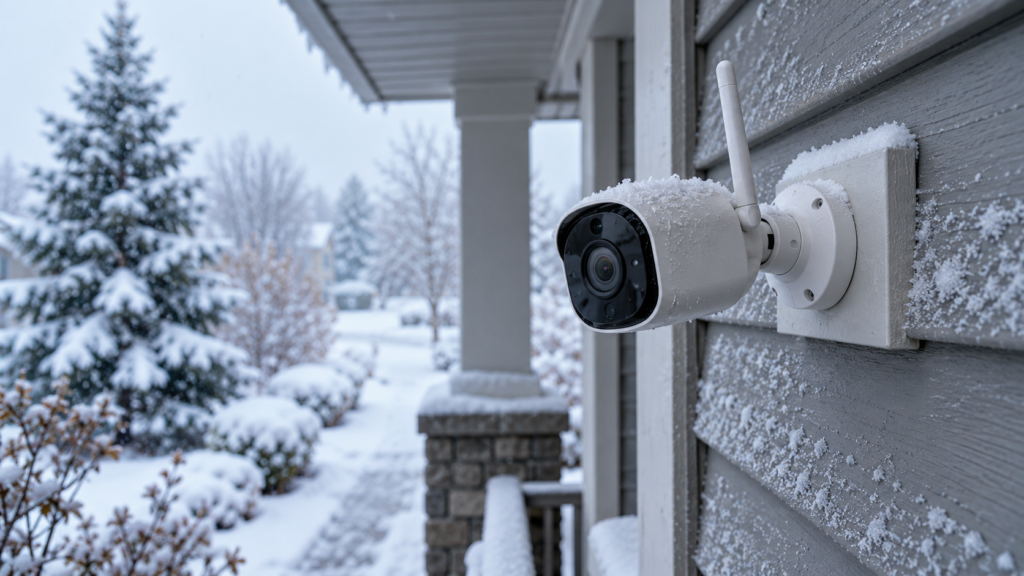
Hardwired PoE cameras sidestep the issue entirely by drawing continuous power rather than relying on a battery. Combined with 4K resolution and AI-based motion analytics that distinguish people and vehicles from blowing snow, PoE has become the practical standard for anything meant to run reliably through a Canadian winter.
That AI distinction matters more than it sounds. Older motion-detection cameras trigger on any movement, and a windy snowfall produces near-constant false alerts — enough that most people just turn notifications off, defeating the purpose of the camera. Analytics that filter for actual people and vehicles keep the alerts meaningful through the exact months they matter most.
What it costs to install
| System | Cost (CAD) |
| 1–2 WiFi cameras, installed by Pixl | From $200 before tax |
| 4-camera PoE 4K system (turnkey) | Free custom quote |
| 8+ camera AI system | Free custom quote |
| Commercial small office (8–10 cams) | Free walkthrough & quote |
| Cloud storage / pro monitoring | $5–$50/month |
Does a camera actually lower your insurance?
Some insurers discount home insurance for a centrally monitored alarm system (Desjardins, for example, advertises up to 10%), and vendors cite savings of 5 to 20% for ULC-listed monitoring. Cameras alone may not qualify. The discount is tied specifically to ULC-listed professional monitoring, not just having a camera on the porch, so it’s worth confirming with your insurer exactly what qualifies before assuming the discount applies.
Who's actually allowed to install this
Camera installation touches licensed trades in most provinces, and it’s worth checking before you hire. British Columbia requires a Security Worker Licence under the Security Services Act, including a criminal record check. Alberta licenses installers under the Security Services and Investigators Act. Ontario requires a Criminal Record and Judicial Matters Check under the Private Security and Investigative Services Act. Quebec’s Bureau de la sécurité privée licenses installers under its Electronic Security Systems category, with an additional CCQ competency card required on active construction sites.
Need a security camera system installed the right way?
Explore the full security camera guide
Frequently asked questions
Generally yes for video — public sidewalks don’t carry the same privacy expectation as a neighbour’s yard. Audio is the bigger risk: capturing a conversation between two passersby without consent can violate Criminal Code s.184.
In BC, yes in many cases — the OIPC has required strata council authorization for camera installations, and doorbell cameras generally can’t continuously monitor shared hallways.
PoE. Battery-powered wireless cameras lose voltage fast below −20°C, while PoE draws continuous power and keeps working through deep cold.
It can — typically 5–20% — but usually only for ULC-listed, professionally monitored systems, not a standalone consumer camera. Confirm with your insurer.
It can constitute an offence under Criminal Code s.184 if neither party consented and you weren’t part of the conversation. Positioning and disabling audio in sensitive zones reduces this risk.
No. Ontario relies on common law, BC and Alberta use PIPA, Quebec has the stricter Law 25, and other provinces default to federal PIPEDA for commercial use. Where you live changes what applies.
At Pixl, WiFi camera installation starts at $200 for 1 or 2 cameras, before tax. Wired PoE/NVR systems and business systems get a free custom quote, because the price depends on how many cameras you need, the cable runs and the storage.